Hōsensin
Stranger in a Strange LandThe Martians are an ancient, highly verbal people whose language expresses a way of understanding the universe that human languages can only approximate. Through the word “grok,” their language links comprehension with participation and even identity; through their silence about war and weapons, it suggests a culture whose basic concepts may not align with humanity’s. Their quiet presence on Mars complicates human claims to the planet: they neither openly contest settlement nor show the responses Earth’s visitors expect.
Language and the Meaning of Grok
Mahmoud describes Martian as far more complex than English and fundamentally different in the way it maps the universe. He doubts humans can truly think in Martian, apart from the distinctive way Valentine Michael Smith learned it, although a limited, pidgin form is possible. The contrast makes translation more than a matter of finding equivalent words: a human speaker may learn Martian vocabulary without entering the conceptual structure that gives it meaning.
Mahmoud uses “grok” to demonstrate that distance. Its literal meaning is “to drink,” but that simple gloss does not capture its range. Mike confirms the literal sense when Mahmoud tests the word with him, yet Mahmoud explains that it can also convey fear, love, hate, mathematical equality, and other concepts that English treats as separate or even opposed. For Martians, to grok something is to understand it so completely that knower and known become joined. The word thus reaches beyond cognition toward merging, blending, and participation.
That unity carries a paradox. Mahmoud says that Martian hate requires such complete understanding that the hater merges with what is hated; the same understanding necessarily entails love and cherishing. Martian hate, as he imagines it, would therefore be far more intense than the nearest human equivalent. He also connects grokking to the observer’s involvement in what is observed: the act of knowing changes the relationship between observer and object. The Martian word gathers ideas that human thought distributes across religion, philosophy, and science, while remaining almost inaccessible to a human mind shaped by different distinctions.
Human Claims and Martian Silence
The Martians’ relation to human settlement is similarly difficult to interpret. Mahmoud says there is room on Mars for colonization and that the Martians did not object when humans announced plans to leave a colony. But neither did they seem pleased or interested. Humans are already flying their flag and claiming extraterritoriality, yet Mahmoud cannot determine what that status means from the Martian perspective. He compares the situation to an ant city observed beneath glass: the humans may be acting within a larger reality they cannot read.
This uncertainty matters because human political and legal assumptions do not necessarily describe what is happening on Mars. The human visitors cannot tell whether the Martians regard the colony as a neighbor, an experiment, or something else entirely. Mahmoud’s admission that he was “never able to grok it” makes the language’s central concept a measure of the explorers’ limit: they can report what the Martians did not visibly resist, but cannot claim to know how the Martians understand their presence.
Culture Without Familiar Categories
Jubal considers the Martian culture in relation to the human division between Apollonian and Dionysian societies. Although he has not visited Mars, he argues that even Zuni culture might seem Dionysian by comparison. Mike, raised in an extremely Apollonian culture, appears to Jubal to have come from a society that is not aggressive. Mahmoud offers linguistic evidence that supports the possibility: he believes Martian has no words for war, weapons, or fighting.
The claim prompts an argument over whether a people can act on a concept without naming it. Jubal points out that animals fight and ants conduct wars; Mahmoud answers that a verbalizing species cannot avoid forming words for the concepts it knows. If Martians understand war, he reasons, their language must have a word for it. The exchange does not settle the question, but it reveals how readily humans project familiar categories onto Martian life—and how difficult it is to distinguish absence of a word from absence of a practice. For Mahmoud, Martian language offers a way to analyze Martian culture; for Jubal, the inference remains open to challenge.
Contact, Observation, and Human Settlement
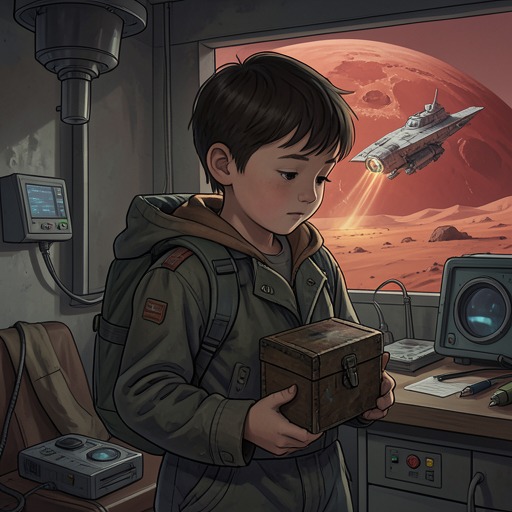
The Martians’ behavior toward the human colony reinforces the gap between human expectations and Martian priorities. After the Champion leaves Mars carrying Mike, the Old Ones observe the departure and keep watch on the unusual “nestling” sent back with the ship, but make no comment. They consider it too early to grok the outcome. Meanwhile, twenty-three humans remain on Mars, where they manage an environment lethal to unprotected humans but, in some respects, less difficult than Antarctica. The Martians leave them alone.
One of the twenty-three dies after an undiagnosed illness described as heartbreak or homesickness. The Old Ones cherish the wounded spirit and send it back where it belongs for further healing. This is the only individual human fate in the passage that the Martians directly address, and their response is not presented as a political intervention in the colony. The contrast is striking: they leave the settlers’ practical affairs alone while treating the departed person’s spirit with care.
By the time the next human party arrives, the Martians are uncritically helpful as the advance guard builds half-buried pressure domes. The work proceeds faster than planned, allowing the humans to begin estimating the effort required to free oxygen bound in Martian sands for future generations. The Old Ones neither assist nor obstruct those long-range plans; in their judgment, the time for involvement has not yet come. Their restrained presence—watching, allowing, and sometimes helping without explanation—leaves human settlement materially possible but intellectually unresolved. The Martians’ significance lies in that unresolved encounter: humans can occupy the planet and make plans for its future without knowing whether they have understood the people who were already there.